
Custom Application Development & Support, Priced by Scope
Bespoke business applications built and then owned long-term, including legacy PHP and CodeIgniter rescue for platforms whose developer left.
Platforms we support
WordPress, Shopify, and Webflow are content management systems: they assume pages and posts. Membership systems, equipment-level tracking, quote-to-approval workflows, and multi-role dashboards aren't content, they're software, and a custom application is the platform built for that shape of problem.
A custom web application is software built around your workflow instead of a CMS plugin stack bent to fit it: an admin interface, a customer-facing frontend, backend APIs, and integrations to whatever systems already run the business. The team builds and operates these on CodeIgniter and PHP, Node.js and Next.js, and AngularJS, with individual engagement history across insurance, fitness and wellness, and manufacturing.
The tell is a workflow, not a page. A CMS can display content about that workflow; it can't run it without a growing pile of plugins fighting each other. When the audit finds this pattern, the honest recommendation is a custom build, not a CMS with more workarounds bolted on.
Different permissions for different people, not one shared login.
Data syncing with hardware or another system as it happens.
Escalation logic a page builder has no concept of.
A dashboard pulling from more than one system at once.
The same four layers on every build. One platform in our engagement history runs a fleet of Raspberry Pi devices in gyms and health clubs, syncing workout and biometric data to a central admin over API in real time; another connects a manufacturing company's public product catalog directly into their internal ERP through a multi-tier approval workflow. Neither fits inside a page-and-post model.
Staff manage records and permissions.
What the people using it actually see.
Connecting admin and frontend.
CRMs, payment processors, hardware in the field.
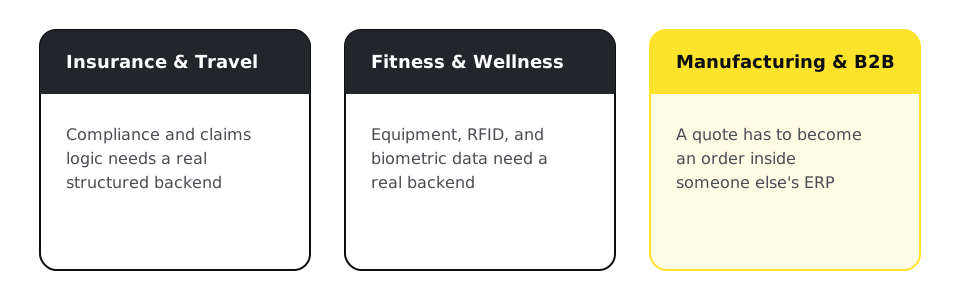
Insurance and travel protection, where compliance and claims logic have to live somewhere more structured than a page builder; fitness, health, and wellness, where equipment, RFID, and biometric data need a real backend; and manufacturing and B2B, where a quote has to become an order inside someone else's ERP. Every one of these has run under one continuous engagement since before Breezy Sites existed as a company, which is the actual argument for hiring the team that also stays to operate what it built.
Yes: dependency updates carry more risk on business logic than on a theme, and legacy PHP and CodeIgniter platforms in particular tend to outlive the developer who wrote them. We take over undocumented applications routinely, on the Custom Application Development & Support page, and the support retainer that follows a build lives on the Website Management page.

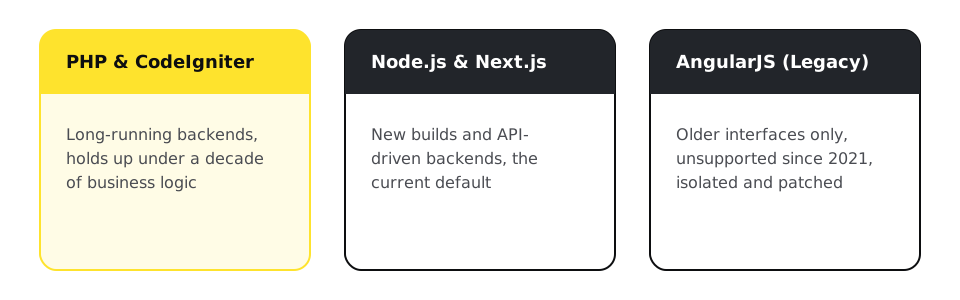
PHP and CodeIgniter for the long-running backends we operate, since it holds up under a decade of business logic without a rewrite. Node.js and Next.js for new builds and API-driven backends, the current default for a reason: server-first rendering and a typed stack end to end. AngularJS shows up in older device and admin interfaces we still maintain, and it needs its own honesty: Google ended AngularJS support in 2021, and new high-severity vulnerabilities keep surfacing in code nobody patches anymore. We isolate and patch what's running, and migrate off it on the evidence, not on panic.
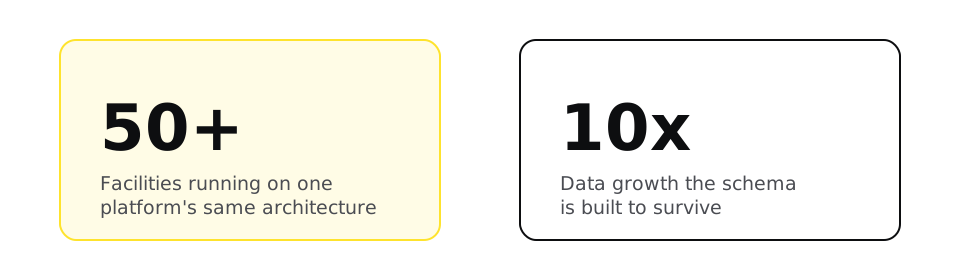
Not a buzzword, four practical decisions: separating the admin, customer, and API layers so each one scales on its own schedule instead of together; a database schema that survives 10x the data without a rewrite; infrastructure that scales the resource under load rather than the whole server; and monitoring that catches the bottleneck before a customer does. One platform in our engagement history grew from a single gym to 50+ facilities on the same architecture, running on AWS. That infrastructure layer is its own discipline, covered on the AWS Infrastructure Support page.
Bespoke business applications built and then owned long-term, including legacy PHP and CodeIgniter rescue for platforms whose developer left.
A $795 codebase and infrastructure audit for an app nobody currently documents.
Zero-data-loss AWS migrations and ongoing infrastructure ownership: EC2, RDS, S3, Route 53, load balancing, disaster recovery.
Going deeper
No. Most business websites are genuinely content, and a CMS is the faster, cheaper, correct answer. Custom makes sense specifically when the product is a workflow: roles, approvals, device data, or integrations a plugin stack can only approximate.
CodeIgniter and PHP for the majority of long-running platforms we operate, Node.js and Next.js for newer builds and APIs, and AngularJS on older interfaces still in production. The framework follows the requirement and what is already running, not a house preference.
Not on its own. Google ended AngularJS support in 2021, so there are no more official security patches, and new high-severity vulnerabilities keep getting found in it. Running it is a maintenance decision, not a technical one: isolate it, patch what you can, monitor it, and migrate off it once the evidence justifies the cost, which we handle as part of a management retainer.
Yes, including undocumented legacy PHP, CodeIgniter, and AngularJS platforms. Inventory and documentation come first, stabilization second, a rewrite only if the evidence supports one, detailed on the Custom Application Development page.
If it is architected to. Separating the admin, customer, and API layers, choosing a database schema that survives 10x the data, and putting the right infrastructure underneath are decisions made at build time, not patched in after growth breaks something. We have taken a single-location platform to 50+ facilities on the same architecture.
Yes. KPI dashboards, leaderboards, and cross-system reporting are a normal part of the admin layer on these builds, not a separate add-on.
By scope, integrations, and support tenure, the same three drivers as any custom engagement; there is no fixed starting price because scopes vary by an order of magnitude. A Strategy Hour or the $795 audit is the honest starting point.
Platforms we support
A technical audit is the honest first step if you already have a custom application and no idea what state it's in.