
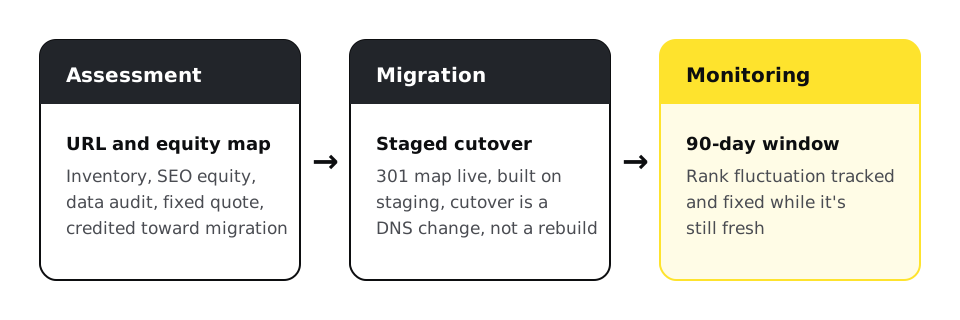
1. Assessment
A URL inventory, an SEO equity map, and a data extraction audit, ending in a fixed quote. The $495 fee credits toward the migration.
Website migration services
Leave your platform. Keep your rankings. Full 301 redirect mapping, staged cutover, and a 90-day rank-monitoring window, delivered as a guaranteed process with a fixed quote before anything moves.
migration timeline
cutover is a DNS change, not a rebuild-in-place
You can migrate a website without losing SEO if every old URL 301-redirects to its new equivalent and the cutover is staged rather than abrupt. The $495 Migration Risk Assessment maps your URLs, SEO equity, and data before quoting a fixed price; migrations start at $1,500 and include 90 days of post-migration rank monitoring.
Not if the migration is done properly, whether you are leaving Squarespace, Wix, Webflow, or WooCommerce. Rankings attach to URLs, and a complete 301 redirect map transfers that equity to the new site; what kills rankings is skipping URLs, changing content during the move, or cutting over without a staging pass. Expect some fluctuation in the first weeks, which is why the engagement includes a 90-day monitoring window rather than ending at launch. The full before, during, and after list is in thewebsite migration SEO checklist.

A URL inventory, an SEO equity map showing which pages carry your rankings, a data extraction audit, and a fixed project quote. The fee credits toward the migration. Why we assess before quoting: platform escapes fail on surprises, and the assessment removes them.
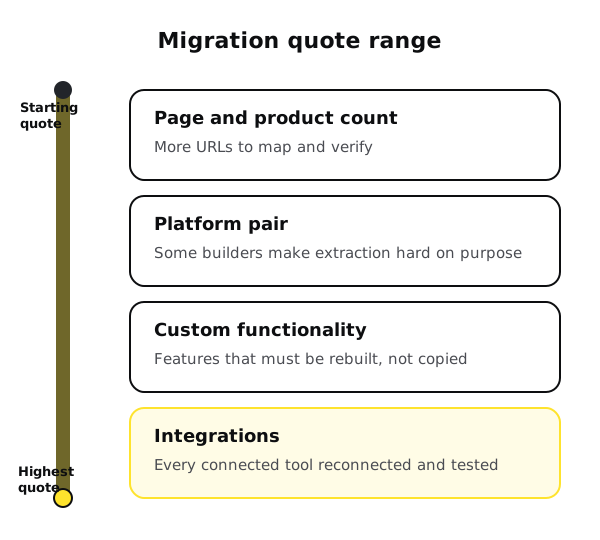
Migrations are quoted from $1,500. For market context, one published 2026 guide puts complex or e-commerce migrations at $5,000 to $50,000+. What moves the number: page and product count, the platform pair (some builders make data extraction hard on purpose), custom functionality that must be rebuilt, and integrations. The assessment turns those variables into a fixed quote, and the quote is the price. The published ranges by move type, provider, and site size are in thewebsite migration cost guide.
The same six steps run on every platform pair, in this order, because each one depends on the one before it.
A URL inventory, an SEO equity map, and a data extraction audit, ending in a fixed quote. The $495 fee credits toward the migration.
The new site is built and verified on staging while the old one keeps running.
One entry per old URL, hand-built, with no wildcard rules for pages that carry rankings.
Content, metadata, forms, and every redirect checked before any DNS change.
A DNS change in a low-traffic window, with the redirect map live from the first minute.
Rank and traffic tracking after launch, to tell normal settling from a real problem.
The same zero-downtime discipline applies below the website: servers and databases. We move applications and data onto or between AWS environments (EC2, RDS, S3, Route 53) with zero data loss, staged DNS cutover, and disaster-recovery configuration. The team has run multiple zero-data-loss AWS migrations on production platforms. Quoted from $2,500by data volume, service count, and downtime tolerance. Ongoing AWS infrastructure support continues after the migration lands.

Every migration produces a file like this covering every URL on the old site:
/shop/blue-widget301/products/blue-widget/
/about-us301/about/
/blog/2023/05/big-news301/blog/big-news/
apache · .htaccess
# .htaccess excerpt - one entry per legacy URL, no wildcards for money pages
Redirect 301 /shop/blue-widget        https://example.com/products/blue-widget/
Redirect 301 /about-us                https://example.com/about/
Redirect 301 /blog/2023/05/big-news   https://example.com/blog/big-news/
The unglamorous truth of SEO-safe migration is a spreadsheet with hundreds of rows like these, each one verified after cutover.
The new site is built and verified on staging while the old one keeps running; the cutover is a DNS change, not a rebuild-in-place. Visitors never see a construction page, forms keep working, and if verification fails, the cutover simply doesn't happen that day. It's a process guarantee, not a promise that DNS physics stop existing.
Leave your platform. Keep your rankings.
Zero-downtime migrations with full 301 redirect mapping and SEO preservation, a guaranteed process at a fixed quote.
Stop guessing what's wrong with your website. Performance, security, SEO infrastructure, AI-readiness, and a prioritized fix list you can execute with us or anyone else.
Predictable monthly retainers that keep your website updated, secure, backed up, and monitored, on any platform, including custom PHP/CodeIgniter applications.
Senior engineering judgment on demand: fixed-fee technical audits, one-hour strategy sessions, fractional CTO engagements, and custom application development & support.
Every platform migration we run, and the guaranteed process behind it.
The exact 301 mapping and cutover process for landing on WordPress.
The exact 301 mapping and cutover process for landing on Shopify.
Shopify import limits, redirect rules, and what happens to your plugins, mapped before any quote.
CMS item caps, stacked pricing, or a plugin-shaped feature Webflow structurally can't reach, mapped before any quote is set.
Two paths off a slow WordPress site: a full migration to Astro, or headless WordPress with WPGraphQL feeding Astro or Next.js.
Who carries hosting, updates, and security, and what leaves with you.
Hosting lock-in, product export limits, and when a store should move.
Custom code, upkeep, and what a Squarespace export carries.
Ownership, upkeep, extensibility, and what an export leaves behind.
Going deeper
Inventory every URL, build a one-to-one 301 redirect map, keep content and metadata unchanged during the move, verify everything on staging, cut over in a low-traffic window, and monitor rankings afterward. Rankings attach to URLs, so an unmapped URL is where traffic is lost.
A 301 redirect permanently forwards an old URL to its new address, and the map is the complete list of those pairs. It matters because search rankings attach to URLs: a missing redirect orphans that page's equity, and enough missing redirects looks like your site disappeared.
Yes. Products, customers, and orders move in batches within Shopify's import limits, every old product, category, page, and post URL gets a one-to-one 301, and each WooCommerce plugin is mapped to a Shopify app or native feature during the assessment. Our WordPress-to-Shopify migration guide covers the limits in detail.
Extract products, customers, and orders first and audit the extraction before touching anything else. Then build on Shopify staging, map every URL including collection and product pages, and cut over in a low-traffic window with the redirect map live from minute one. Store migrations fail on data extraction more than on SEO. Our Wix-to-Shopify migration guide covers this exact move in detail.
Small sites: two to four weeks including staging and verification. E-commerce and content-heavy sites: one to three months, driven mostly by data volume and how cooperative the source platform is. The assessment gives you a real timeline, not a hopeful one.
Nothing, if it's planned. Email runs on MX records, which we inventory during the assessment and leave untouched at cutover. Email breaking during a website migration is a sign the DNS change was done carelessly.
Yes. Zero-data-loss server and database migrations are a standing part of our AWS infrastructure work: replicated data, verified parity, staged DNS cutover, and disaster recovery configured on the new environment. We've done this repeatedly on production platforms.
Yes, for 90 days. Fluctuation in the first weeks is normal; the monitoring window exists to distinguish normal settling from an actual problem, and to fix the problem while it's fresh.
When the limits you're hitting are cheaper to work around than to escape. If your platform serves your traffic, your team can operate it, and the pain is cosmetic, we'll tell you to stay. The assessment sometimes ends exactly that way.
Quoted from $1,500 after the $495 assessment, which credits toward the project. Complex e-commerce replatforms legitimately reach five figures; what moves the number is page and product count, platform pair, custom functionality, and integrations.
Zero downtime migrations
The audit maps your current platform's real limits before you commit to a migration plan, so the move fixes the actual problem.