
The Same Grounded Architecture, Pointed at Your Docs Instead of Your Catalog
Grounded AI assistants built from your actual content, tested against wrong answers, capped with a token budget, and monitored in production.
AI assistants
Your store search returns zero results for queries your catalog can answer. Semantic search fixes the gap between how shoppers talk and how your product fields are written.
Semantic product search matches meaning instead of keywords, so misspellings, synonyms, and need-based queries return real products instead of zero results. Built catalog-aware for Shopify and WooCommerce with guided selling, quoted from $6,500 by catalog size, integrations, and selling logic, plus the standard AI-ops monitoring attach.
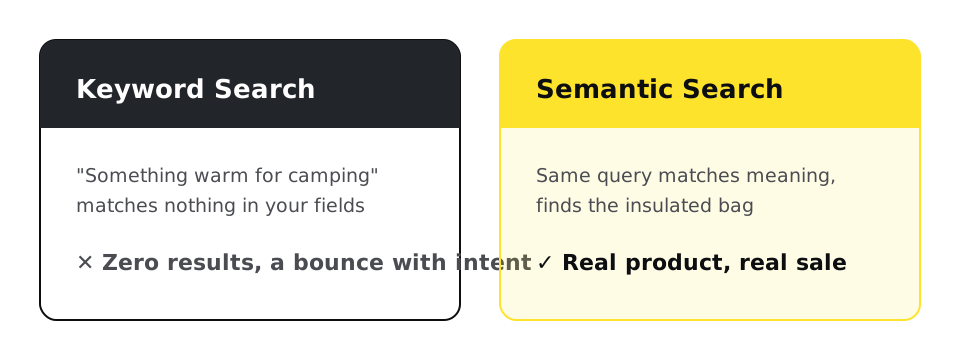
Shoppers describe needs and catalogs describe SKUs. Keyword search demands the shopper guess your vocabulary; every failed guess is a bounce with intent. Semantic retrieval embeds both sides into meaning-space, which is why a typo or a paraphrase still lands on the right product.
A good floor salesperson answers a vague request with a question. The assistant does the same, narrowing the catalog live from a budget or use-case question. It is the same grounded architecture as our knowledge bases, pointed at your product data.

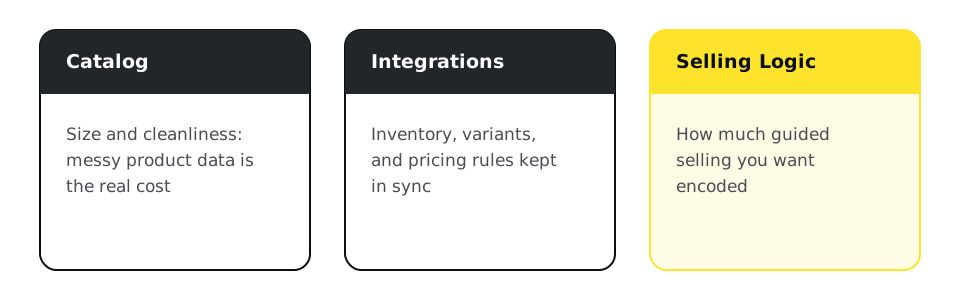
Catalog size and cleanliness (messy product data is the real cost), integrations (inventory, variants, pricing rules), and how much selling logic you want encoded. Quoted from $6,500, fixed once written, with the monitoring attach from $497/month on the Website Management page, because catalogs change daily and the index must follow.
Grounded AI assistants built from your actual content, tested against wrong answers, capped with a token budget, and monitored in production.
An AI-readiness assessment before anything gets built.
Predictable monthly retainers that keep your website updated, secure, backed up, and monitored, on any platform, including custom PHP/CodeIgniter applications.
A conversational assistant instead of, or alongside, search and filtering.
Catalog-aware search and guided selling wired directly into a Shopify store.
The dedicated page behind the monitoring attach: quality checks, re-indexing, and token budgets.
Going deeper
Built-in search matches words in product fields; semantic search matches meaning. "Something warm for camping" finds your insulated bag even though no field says warm or camping.
Typos, yes, natively; meaning survives misspelling. Multi-language depends on catalog and model choices and gets scoped in the quote.
No. Retrieval runs serverless and the widget loads deferred; store speed is our other specialty, and we don't break it to add search.
Scheduled re-indexing plus webhook-triggered updates for inventory and price changes, covered by the monitoring attach. A search index that lags your catalog sells ghosts.
Fewer zero-result searches, higher search-to-cart conversion, and the query log itself, which tells you what shoppers wanted that you do not stock. We baseline before launch so the after is measurable.
AI assistants
The audit includes an AI-readiness read on your catalog, so you know what semantic search would actually need before you scope it.