
Store search no results typo: the vocabulary gap
Your catalog says insulated softshell, 200g fill. The shopper types really warm jacket. Keyword search finds no overlap and returns nothing, and the shopper may not retry with better vocabulary. Every zero-results query in your search analytics is this gap, measured, and it is the first number to pull.
| Shopper types | What each search does |
|---|---|
| Your catalog's own words | Both find it. Keyword matching is exact when the shopper knows the name |
| A different word for the same thing | Keyword finds nothing. Semantic finds it by meaning |
| A need, such as something warm for winter hiking | Keyword finds nothing. Semantic returns related products |
| A one-letter typo | Depends on the platform's spelling handling, which is separate from semantic matching |
Ecommerce site search conversion: what semantic retrieval changes
Semantic search turns products and queries into numbers that sit close together when their meanings are close, so warm, insulated and 200g fill land near each other. A match no longer needs shared words. It depends on how complete and consistent your product titles, descriptions and tags are.
Shopify's help center(opens in a new tab) lists what its semantic understanding reads: product title, description, type, category and tags. It does not use product images. A thin description limits what any semantic search can match, so catalog text sets the ceiling.
Whether better matching lifts conversion is a measurement on your store, not a promise. Compare orders from search sessions before and after any change.
The same embedding idea powers RAG chat with your documents, where it finds passages instead of products.

Semantic product search in practice: hybrid ranking
Hybrid search runs keyword and semantic matching together and merges the results. Azure AI Search's documentation(opens in a new tab) describes a single query that runs full-text and vector search in parallel and merges the results with reciprocal rank fusion into one ranking. Keyword matching keeps exact names and codes reliable, and vectors cover descriptions and needs.
Ask any search vendor whether its ranking is keyword only, vector only or hybrid, and how it merges the two. The answer decides what happens to a shopper who types an exact SKU.
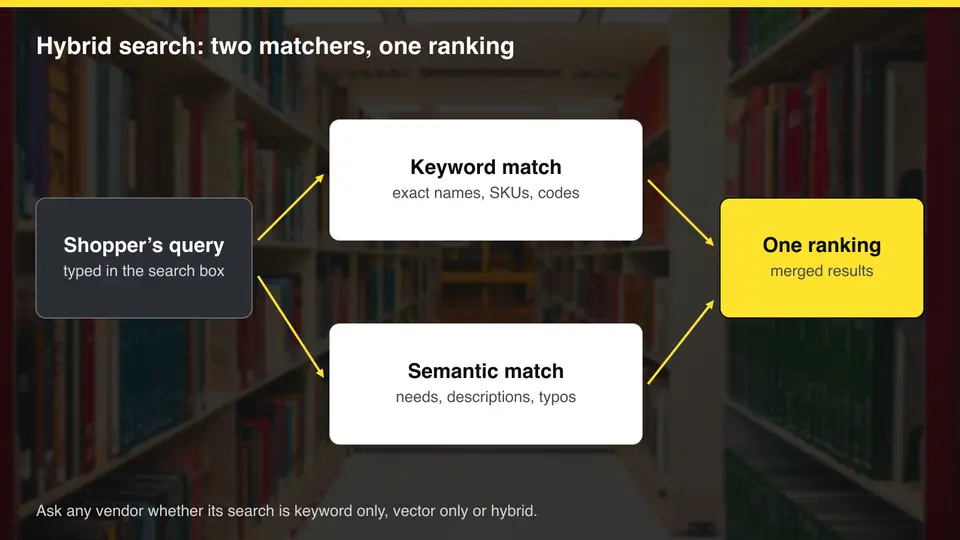
| Shopper types | Which half carries it |
|---|---|
| An exact product name or SKU | Keyword matching, which is precise |
| A description of what they need | Semantic matching, which finds meaning without shared words |
| A brand plus a vague word | Both, merged into one ranking |
Check what your platform already does
Shopify's help center says semantic understanding is included in online store search and needs no switch in the Search & Discovery app. It also applies to product suggestions in predictive search. On Shopify you may already have the feature, so test it before paying for a replacement.
On WooCommerce or another platform, ask the same questions of the search plugin you run. Check what it actually matches instead of trusting the feature name.
Run the audit as a loop, not a project. Shopify's Search & Discovery analytics(opens in a new tab) reports searches by query, searches with no results, searches with no clicks and purchase rate over the last 30 days, so the report that finds a gap also shows whether a fix worked. Keep the failing queries as a fixed test list, and rerun it after every catalog or setting change.
For stores that sell in several languages, Shopify's changelog(opens in a new tab) says semantic search has supported multiple languages since September 2024.
Export a month of zero-results queries
Group them as typos, synonyms and needs
Retype each group on the live store
Count what still returns nothing
Fix the catalog, tune the platform or scope a build
When a custom semantic search build makes sense
A custom build fits when the built-in search leaves a gap you have measured. Our e-commerce shopping assistant is quoted from $6,500, and scoping depends on catalog size. It adds guided selling and is built catalog-aware for Shopify and WooCommerce.
If the audit shows a short list of specific misses, fix the catalog text first. That is cheaper than a build.
- Your store is not on a platform whose search already matches meaning.
- Shoppers describe needs, and one clarifying question would serve them better than a list of results.
- You have measured the gap, and the sales it costs exceed the price of the build.
Questions about semantic search vs keyword search
Is semantic search better than keyword search?
Neither wins everywhere. Keyword matching is exact when a shopper knows a name or code. Semantic matching helps when shoppers describe what they want in their own words. Many stores need both, so test your own queries instead of picking a side.
Does Shopify have semantic search built in?
Shopify's help center says semantic understanding is included in online store search, with no setting to switch on in the Search & Discovery app. Check the current help page, since platform features change.
What is hybrid search?
Hybrid search runs keyword and vector search in parallel and merges the two result lists into one ranking. Keyword matching is precise for names and codes, and vectors find products described in other words. Ask your search vendor which one yours is.
How do I know whether search is costing me sales?
Export a month of zero-results queries. If the list is short and specific, keyword search may be enough. If it is long and full of ordinary phrases, shoppers are failing to find products that exist.