
Work Through Your Page Inventory in a Strategy Hour
An hour to work through your page inventory and the deciding question.
Platform comparisons
The honest version: Astro wins by default on content sites because it ships no JavaScript unless asked; Next.js wins when your site is secretly an application. We run both in production, including this site.
For content-dominant sites, Astro's islands architecture ships less JavaScript and produces better Core Web Vitals with less effort; for application-dominant sites, Next.js's server components and data model justify their runtime weight. The deciding question is what fraction of your pages need client-side state, not which framework benchmarks faster.
Zero client JavaScript unless a component opts in. A default that ships nothing beats a framework you must configure toward nothing: LCP has less to wait for, INP has less to fight. This site is Astro static-first for exactly these reasons, and its field data is our demonstration.

Real applications: authenticated dashboards, complex mutations, per-user rendering. Server components have narrowed the payload gap, and the ecosystem around data fetching is deeper. Building an app in Astro means reassembling what Next.js includes; that trade rarely pays.
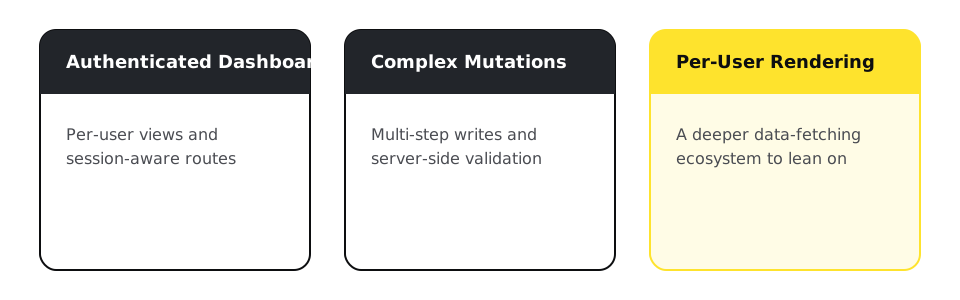
Choosing by benchmark instead of by page inventory. Count your routes, then match the result below rather than forcing one framework to be both. Either way the operations discipline is identical, on the Next.js & Astro platform page.
Most routes are content with islands of interactivity: Astro.
Authenticated dashboards, complex mutations: Next.js.
Split them: marketing on Astro, app on Next.js.
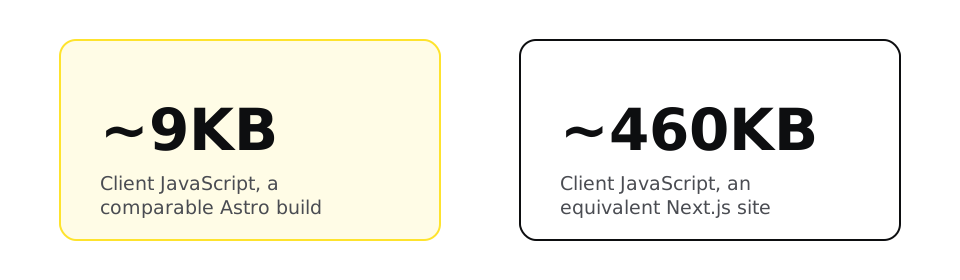
Partly. Independent 2026 benchmarks still show a comparable Astro build shipping around 9KB of client JavaScript against roughly 460KB for an equivalent Next.js site, a real two-to-three-times load-speed gap on content pages. React Server Components and better default caching in Next.js 15 and 16 have narrowed that for application routes, and edge deployment now cuts latency by 40 to 60 percent for a globally distributed audience regardless of which framework sits on top of it. The gap that matters is still architectural, not release-year: less JavaScript on the wire keeps landing you a faster Largest Contentful Paint and a lower Interaction to Next Paint, on content pages specifically, no framework update changes that math.
An hour to work through your page inventory and the deciding question.
Manual engineering against real-user field data, not another caching plugin. Fixed-fee diagnostic and remediation sprints measured against 28-day CrUX data.
Evidence-graded audits of how ChatGPT, Perplexity, and AI Overviews actually see your site, documented crawler behavior, not agency folklore.
Ongoing support, speed work, and operations for both frameworks.
Senior engineering judgment on demand: fixed-fee technical audits, one-hour strategy sessions, fractional CTO engagements, and custom application development & support.
Going deeper
For content pages, usually, because it ships less JavaScript by default. For applications, the comparison stops being meaningful; you're comparing a content architecture to an app architecture.
Yes, via islands and server-rendered routes. The question is proportion: a few dynamic islands is Astro's sweet spot; a site that's mostly dynamic is an app wearing a content site's clothes.
Indirectly and importantly: whatever renders client-side is invisible to most AI crawlers. Astro's static output passes by default; Next.js passes when you render server-side. The audit checks either.
Only if your page inventory says so and your current field data is actually suffering. Migration costs are real; sometimes the honest fix is optimizing what you have.
Astro, static-first, with page content owned as code rather than pulled from a CMS. We publish that because eating our own cooking is the only comparison credential worth having.
For application routes, meaningfully, through React Server Components and better caching. For pure content pages, no: less JavaScript on the wire still wins, and that is architectural, not a release-year fact that changes with the next version bump.
Platform comparisons
The audit checks whether your current framework is actually the bottleneck, or whether the render path is.