
Every Other Platform Migration We Run
Every platform migration we run, and the guaranteed process behind it.
Migrations
Products, customers, orders, and rankings, moved with the store still trading. The risky part isn't Shopify; it's getting your data out of Wix intact, and that's where we start.
A Wix-to-Shopify migration moves products, customers, orders, and SEO equity onto Shopify while the store keeps selling. The $495 Migration Risk Assessment audits your Wix data extraction and URL inventory first, then produces a fixed quote; typical market pricing for DTC stores runs into five figures, and our quote states its drivers.
Wix makes data extraction the hard part: product variants, customer records, and order history export incompletely or in shapes Shopify doesn't accept. The assessment audits exactly what your store can extract before anyone commits, because discovering a data gap mid-migration is how stores end up trading from two platforms at once. Process details live on the migrations hub.

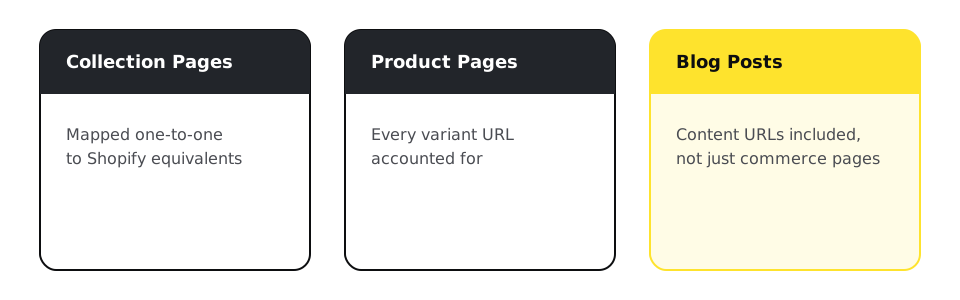
Every Wix URL gets a 301 to its Shopify equivalent, including collection pages, product pages, and blog posts. Wix's URL structure differs from Shopify's, so the map is genuinely one-to-one work, not a wildcard rule. Rank monitoring runs 90 days after cutover.
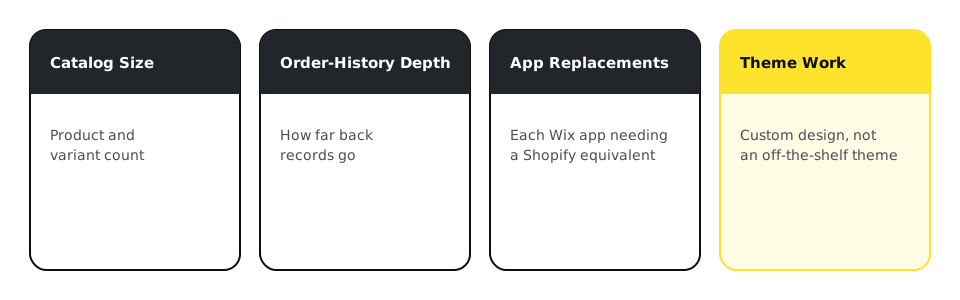
The $495 assessment produces the fixed quote. Market reality for DTC stores runs into five figures, with heavy customization pushing higher; catalog size, order-history depth, app replacements, and theme work drive the number. The quote itemizes those drivers so you can see your store in it.
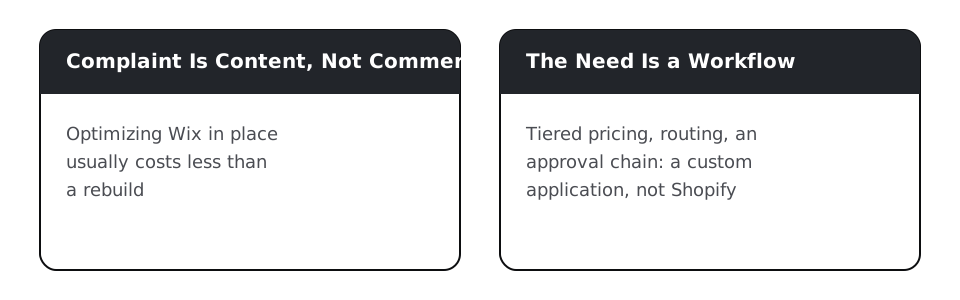
Two cases where migrating solves the wrong problem. If the real complaint is content and SEO rather than commerce, the assessment usually finds that optimizing Wix in place costs less than a rebuild. And if the actual need is a workflow Shopify's own checkout and app ecosystem were never built for, tiered B2B pricing, multi-warehouse routing, an approval chain between quote and order, moving to Shopify just relocates the same limitation onto a different platform. That case calls for a custom application built against the commerce platform's APIs, not another migration.
Every migration produces a file like this covering every URL on the old site:
apache
# .htaccess excerpt - one entry per legacy URL, no wildcards for money pages
Redirect 301 /shop/blue-widget        https://example.com/products/blue-widget/
Redirect 301 /about-us                https://example.com/about/
Redirect 301 /blog/2023/05/big-news https://example.com/blog/big-news/Every platform migration we run, and the guaranteed process behind it.
Manual engineering against real-user field data, not another caching plugin. Fixed-fee diagnostic and remediation sprints measured against 28-day CrUX data.
Predictable monthly retainers that keep your website updated, secure, backed up, and monitored, on any platform, including custom PHP/CodeIgniter applications.
What we fix or maintain on Wix if you decide to stay instead of migrating.
Ongoing Shopify support once the migration is done.
Going deeper
Yes, if every URL 301s to its equivalent and content moves unchanged. Expect a few weeks of fluctuation, which the 90-day monitoring window exists to watch. What kills rankings is skipped URLs, not the platform change.
Products and customers, yes. Order history migrates as records, for reference and reporting; customer passwords can't move between platforms, so accounts trigger a reset flow at first login. The assessment states exactly what your store's data allows.
It should not be offline at all. The Shopify build happens in parallel while Wix keeps trading; the cutover is a DNS change after verification.
It stays live through cutover plus a safety window, then you cancel it. Never cancel the source platform before parity is verified; it is your rollback.
No. If the complaint is content and SEO, optimizing Wix in place is usually cheaper than a rebuild. If the need is a workflow, tiered pricing, warehouse routing, an approval chain, migrating to Shopify just relocates the limitation; that case calls for a custom application instead.
Apps move what exports cleanly and silently drop what does not, and Wix is the platform where the most does not. The assessment exists precisely to find what an app would lose.
Migrations
Before you commit to a store migration, a technical audit can confirm which of your current problems are actually Wix limits and which aren't.