
Get an Hour on Whether Your Catalog Still Fits Squarespace
An hour with your catalog and channels on the table.
Platform comparisons
The line between them is sharper than most comparisons admit: it comes down to whether your store is a section of your site or the business itself.
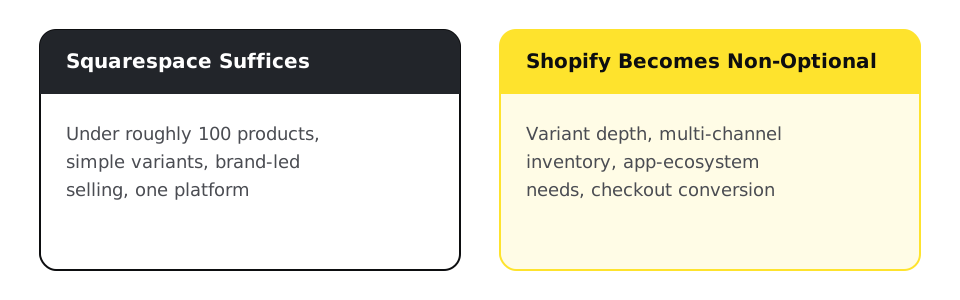
Squarespace Commerce fits stores that are a section of a design-led site: small catalogs, simple variants, standard checkout. Shopify fits stores where commerce is the business: deep catalogs, apps, multi-channel, and checkout optimization. The switch point is when catalog complexity or sales channels outgrow Squarespace's commerce layer, and the move is a documented process starting at $495.
Under roughly 100 products with simple variants, brand-led selling, and checkout that just needs to work. You keep one platform, one bill, and design cohesion. Growth in content doesn't force a move; growth in commerce complexity does.

Linked facts come from the vendor's own documentation, checked 10 October 2026; unlinked cells are our description. Vendors change these policies, so verify before you commit.
Sources, checked 10 October 2026
Variant depth, inventory across channels, app-ecosystem needs (subscriptions, bundles, loyalty), and checkout conversion work. These are not Squarespace weaknesses so much as things it never promised. The tax: app bloat is Shopify's own disease, which is why our Shopify work is half surgery.
Products, customers, and rankings all move, and the order matters: Squarespace's own export omits products, so the audit has to run before anything else, not after. The redirect map comes from that audit rather than guesswork, and the cutover only happens once both are verified, on the Migrations page. Assessment $495, quote fixed after it.
Structured extraction, since Squarespace's export omits products.
One-to-one redirect mapping, hand-built.
The old store keeps trading through the switch.
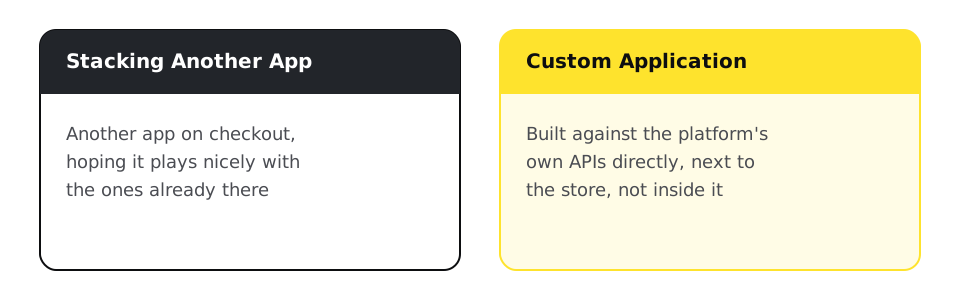
Sometimes. When the actual requirement is tiered B2B pricing, multi-warehouse routing, or an approval chain between a quote and an order, both platforms answer it the same way: stack another app onto checkout and hope it plays nicely with the others already there. Past a certain point that stack becomes the maintenance burden itself. Building against Shopify's Admin and Storefront APIs directly, as a small custom application next to the store, is the honest alternative once app-stacking is the actual problem, not catalog size.
An hour with your catalog and channels on the table.
Leave your platform, keep your rankings: full 301 redirect mapping, staged cutover, and 90-day post-migration rank monitoring, plus zero-data-loss AWS server and database migrations.
Manual engineering against real-user field data, not another caching plugin. Fixed-fee diagnostic and remediation sprints measured against 28-day CrUX data.
What we fix, maintain, or migrate specifically on Squarespace.
What we fix, maintain, or migrate specifically on Shopify.
Going deeper
Up to a real but modest ceiling: small catalog, simple variants, single channel. Plenty of profitable stores live under that ceiling permanently, and they are right to stay.
Catalog complexity, channel expansion, or checkout optimization needs. When you are fighting the commerce layer monthly, the fight costs more than the migration.
Sticker plus apps, yes. The comparison that matters is revenue per visitor against platform cost, and stores that need Shopify's capabilities recover the difference or shouldn't move yet.
Not with full 301 mapping and faithful content transfer, monitored for 90 days. The process is the same ranking-safe migration we run everywhere.
That happens once the need is a workflow, not a catalog: tiered B2B pricing, multi-warehouse routing, or a quote-to-order approval chain. Both platforms answer that with another app on checkout. A small custom application built against the platform API is the honest alternative when app-stacking becomes the real maintenance burden.
Yes, in about an hour, with your catalog and channels on the table. That's a Strategy Hour, and "stay on Squarespace" is a real and frequent answer.
Platform comparisons
If checkout, speed, or SEO already feel like a fight on your current platform, the audit names the actual cause before you switch anything.